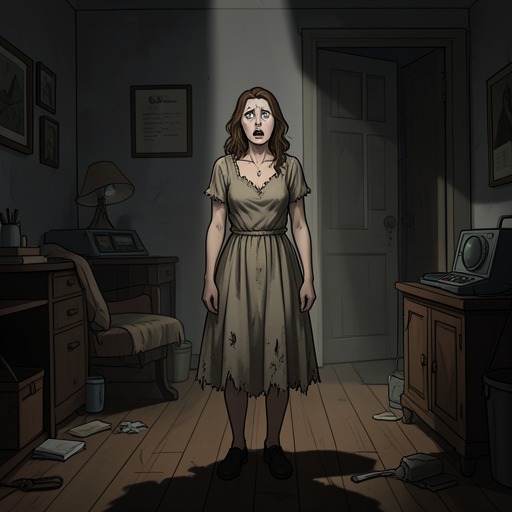
Hazel’s ongoing surveillance at The Hub
Made for LoveHazel’s ongoing surveillance at The Hub turns domestic life into a field of continuous observation. Cameras and scanners record her movements, bodily data shapes the meals she receives, and a brain-linked system gives Byron access to information drawn from her experience. The arrangement is framed as protection and convenience, but its reach leaves Hazel with little meaningful privacy. Her attempts to refuse devices or withdraw from the relationship reveal the central imbalance: Byron can treat surveillance as care, while Hazel cannot escape being made legible to him.
Domestic Monitoring and the Language of Safety
The monitoring first becomes oppressive through its accumulation in ordinary routines. After Hazel’s marriage, she notices Byron commenting on things she does at The Hub even when he is away. Staff members alter the food brought to her each day according to bodily scans she had not known were being taken. No single adjustment necessarily announces itself as an invasion; together, they show that her body is being measured and her habits reported without her informed awareness.
Byron explains the system in the vocabulary of health, happiness, and convenience. He describes the collected information as necessary data and argues that analysis of Hazel’s words and actions can identify her state of mind with almost ninety-seven percent accuracy, despite his lack of a psychology degree. The claim turns intimacy into a technical achievement: rather than asking Hazel what she feels, Byron can rely on a system that purports to infer it. His confidence in measurement does not resolve the question of consent. It makes the disparity sharper, since the ability to interpret Hazel is treated as a benefit to the marriage even as she loses control over what is observed and how it is used.
The monitoring also reaches the bathroom. When Byron finally admits that cameras and scanners are present in every room, Hazel understands that no moment inside The Hub has gone unrecorded. She responds by describing sex as redundant in a relationship where sensors have already entered the private boundaries of her body. Her withdrawal from sex becomes one of the few barriers she can impose. The choice does not disable the system, but it marks a refusal to let technological access stand in for mutual intimacy.
The Sleep Helmet as Care and Surveillance
The Omega Sleep Helmet makes the contradiction between protection and intrusion especially visible. When Hazel wakes in the night with an elevated stress response, Byron’s Sleep Helmet detects her alert state and presents a red question on the bedroom wall, asking whether it should wake him. The design leaves that decision to Hazel because her nightmares are frequent; she has never chosen to wake Byron. Even in a moment of distress, the system translates her body into a signal and routes the resulting choice through a device shared with her husband.
Byron’s helmet is also designed to preserve and monitor sleep. Blue lights travel across its face panel, while an internal delta-wave pattern coordinates with his REM cycle. The helmet blocks light and is intended to prevent sleep disruption. Hazel finds her own helmet unnerving and leaves it on a pedestal on the dresser, where it seems to keep watch through the night. She fears that wearing it would make her feel as if she were rehearsing death, and the speed with which users fall asleep makes the device’s surrender of consciousness part of its appeal as well as its menace.
The helmet’s safety functions extend beyond its wearer. It tracks vital signs, attempts to wake a user if the pulse falls dangerously low, and can alert emergency personnel if the user remains unresponsive. Because Byron wears his Omega model, its partner-awareness feature monitors life within a set radius, including Hazel. The mechanism that could help detect a medical emergency therefore also sustains observation of someone who has chosen not to wear the device. Safety is not simply Hazel’s protection here; it is a technical relation in which her body remains visible through Byron’s equipment.
Brain Access and the End of Mental Privacy
The most radical form of surveillance emerges when Byron claims access to Hazel’s mind. When she asks whether he has put cameras in her father’s house, he answers that her mind is the camera. The statement overturns the apparent distinction between watching a person and accessing what that person perceives: Byron challenges Hazel to ask about things she has seen, thought, touched, or smelled, including memories formed while drunk. He implies that the system may retain more of an experience than Hazel herself can remember.
The brain-linked download also converts location into a means of control. Hazel considers escaping to a remote place beyond the reach of the system, but Byron explains that the prototype has no active GPS because such a signal could be detected. Instead, each download gives the company her exact coordinates. She would have a twenty-four-hour lead, he says, but no practical way to remain beyond reach indefinitely. The absence of a visible tracker does not make the system less powerful: location is disclosed through the recurring process Hazel is trying to evade. Surveillance works not only by recording where she is, but by making her attempt to disappear temporary and predictable.
Byron’s account makes even Hazel’s thoughts part of the struggle. She realizes that he will know what she saw in the bathroom and that he may discover her private reactions at the next download. Rather than make herself less perceptible by avoiding what she sees, she resolves to look even longer. That response does not defeat the system, but it refuses the idea that surveillance should dictate her attention as well as capture it. The resulting privacy crisis is mental and behavioral at once: Hazel must reckon not only with what Byron can learn, but with the knowledge that he may later learn it.
Refusal, Embargoed Devices, and Life Beyond The Hub
Hazel’s resistance takes concrete form in her refusals. When Byron tells her he has placed basic electronics in a weatherproof safe in her backyard, using their anniversary date as the code, she declines to open it and says she does not want to use electronics again. She also refuses his money and asks to separate, imagining a life that would be insignificant and invisible. The offered equipment is not a neutral route to independence when it comes from the person whose systems have made her feel watched.
The contents of the safe deepen that suspicion. When Hazel tries to sell the devices, a buyer identifies them as embargoed Gogol products. Such goods can be customized with unreleased features or sensitive information, and their return to Gogol can command several times their ordinary value. Hazel recognizes that the items may carry surveillance enhancements: what appeared to be a cache of useful gifts may instead be a Trojan horse that extends Byron’s technological reach. Her refusal to trust the devices is grounded in what she learns about their status, not simply in a general dislike of technology.
After leaving The Hub, Hazel’s precautions continue in public. At a library computer, she avoids signing into accounts under her former identity and avoids searching for Byron, Fiffany, or herself, fearing that any search could give an algorithm a clue to her location. Instead, she scans news headlines and picks up occasional mentions. She learns that Byron and Fiffany are now a couple, but the report does not make her abandon concealment. The same informational networks that once helped make her visible remain a threat in her fugitive life. Surveillance thus outlasts the household that organized it: even when Hazel is physically away from The Hub, she must shape her use of technology around the possibility of being found.